
OIRS™ Score Logic
How the OIRS™ Score Works
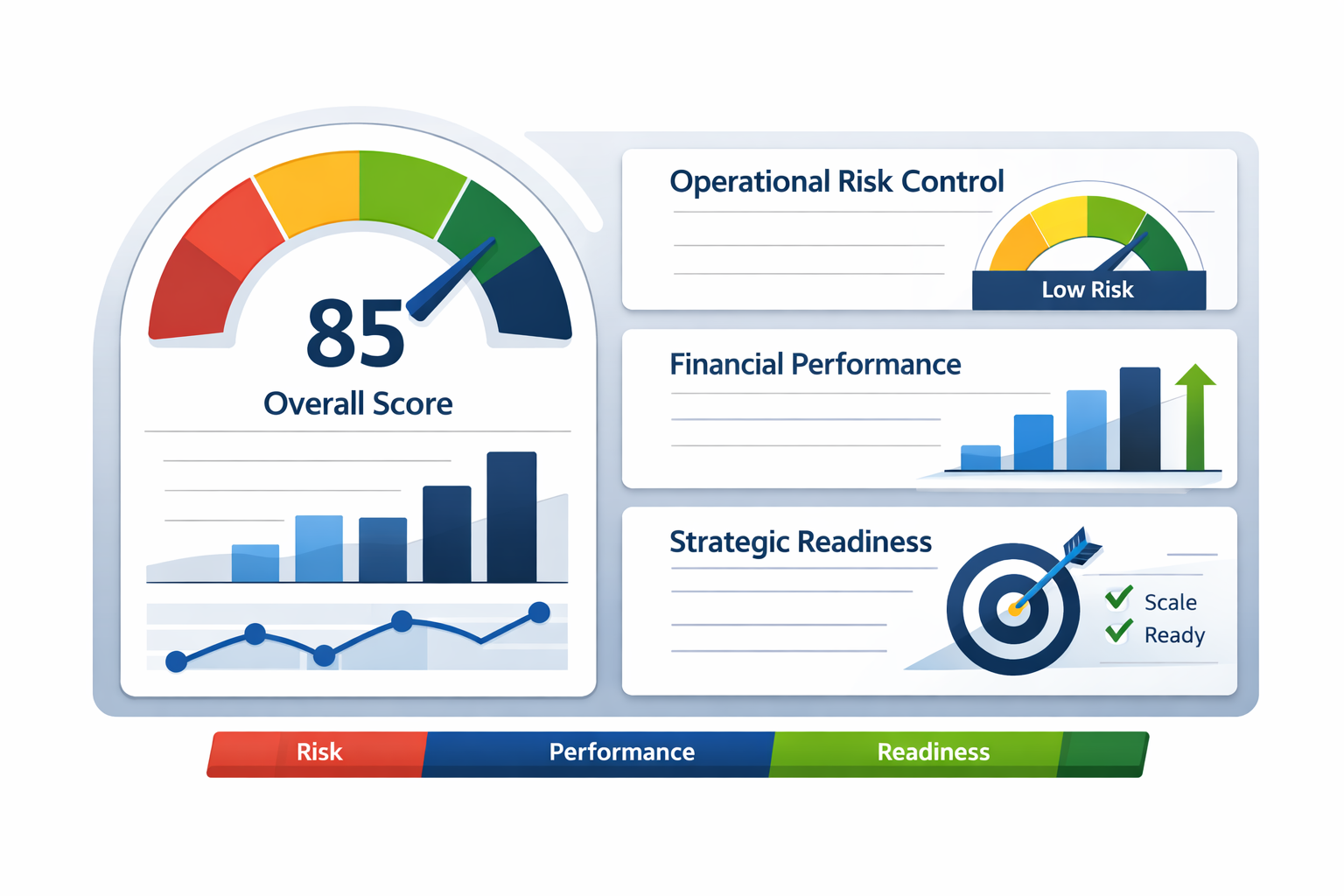
The Operational Intelligence Readiness Score (OIRS™) quantifies how prepared your operation is to run consistently and scale without surprises. It measures readiness across five categories—Vision, Systems, Execution, Culture, and Risk—then normalizes those results into a single composite score. OIRS™ is delivered through automation-first scoring and Forge Dashboard visibility.
What OIRS™ measures
OIRS™ is built to surface the most likely sources of operational instability first—so leaders can prioritize the few fixes that reduce risk and increase execution stability.
Vision
Clarity of goals, priorities, and what “good” looks like—so teams can execute without conflicting direction.
- Alignment on outcomes
- Clarity of priorities
- Decision focus
Systems
Whether the operation has stable systems and standards that hold up under volume, turnover, and change.
- KPI definitions & consistency
- Standard work foundations
- Operating cadence maturity
Execution
How consistently work is performed across shifts and teams—and whether output is predictable under pressure.
- Throughput stability
- Variation by shift/team
- Repeatable routines
Culture
Whether accountability and problem-solving behavior is strong enough to sustain results without constant escalation.
- Ownership & follow-through
- RCA habits & discipline
- Leader enablement
Risk
Exposure to failures, rework, delays, compliance issues, and operational surprises that create cost and customer impact.
- Early warning signal coverage
- Risk driver visibility
- Prevention vs reaction
How scoring works in practice
OIRS™ is designed to be useful operationally—not theoretical. The diagnostic establishes a baseline. After that, score movement is supported by operational metrics and trends (automation-first), without forcing teams to re-take surveys each month.
1) Diagnostic baseline
Your initial diagnostic creates a readiness baseline and highlights the highest-leverage gaps.
2) Operational signals
Trend movement is tied to measurable signals (KPIs, stability indicators, and execution patterns), not opinions.
3) Forge Dashboard delivery
Clients receive score visibility, category movement, and risk-driver emphasis through the Forge Dashboard.
What your scorecard should tell you
A useful scorecard does three things: (1) clarifies posture, (2) shows what is improving or degrading, and (3) identifies the few drivers most likely to create cost, delay, or customer impact if not addressed.
How to use OIRS™ to drive action
OIRS™ is designed to create operating discipline—so leadership attention goes to the right problems at the right time.
- Use category movement to prioritize where to focus this month (not what was loudest this week).
- Use risk drivers to stop recurring issues at the source (not after customer impact).
- Use the package ladder to add structure only when needed: Baseline → Control → Ascent.
- Use Forge OES when the operation lacks reliable execution data and needs a visibility foundation.
FAQ
Is OIRS™ just a survey?
No. The diagnostic establishes a baseline. Ongoing movement is supported by operational signals and trends through an automation-first delivery model.
Do we have to re-take the diagnostic every month?
No. The diagnostic is the baseline. Monthly updates are tied to operational metrics and stability indicators.
Where do we see the results?
Clients receive score visibility and trend movement through the Forge Dashboard as part of package delivery.
Do we need Forge OES to use OIRS™?
Not always. Forge OES is recommended when execution data is unreliable or visibility is too weak to trust trends. If you already have reliable metrics and stable data capture, you can start directly with OIRS™ packages.
What happens after we get a score?
The scorecard highlights posture, category movement, and key drivers—then recommends the most appropriate next step (Baseline, Control, Ascent, or Forge OES depending on data maturity and stability needs).
Explore more
Explore services, packages, and how Forge supports execution visibility.
Start with the diagnostic
Get a readiness scorecard that highlights posture, category movement, and what to fix next to reduce risk and stabilize execution—without adding complexity.